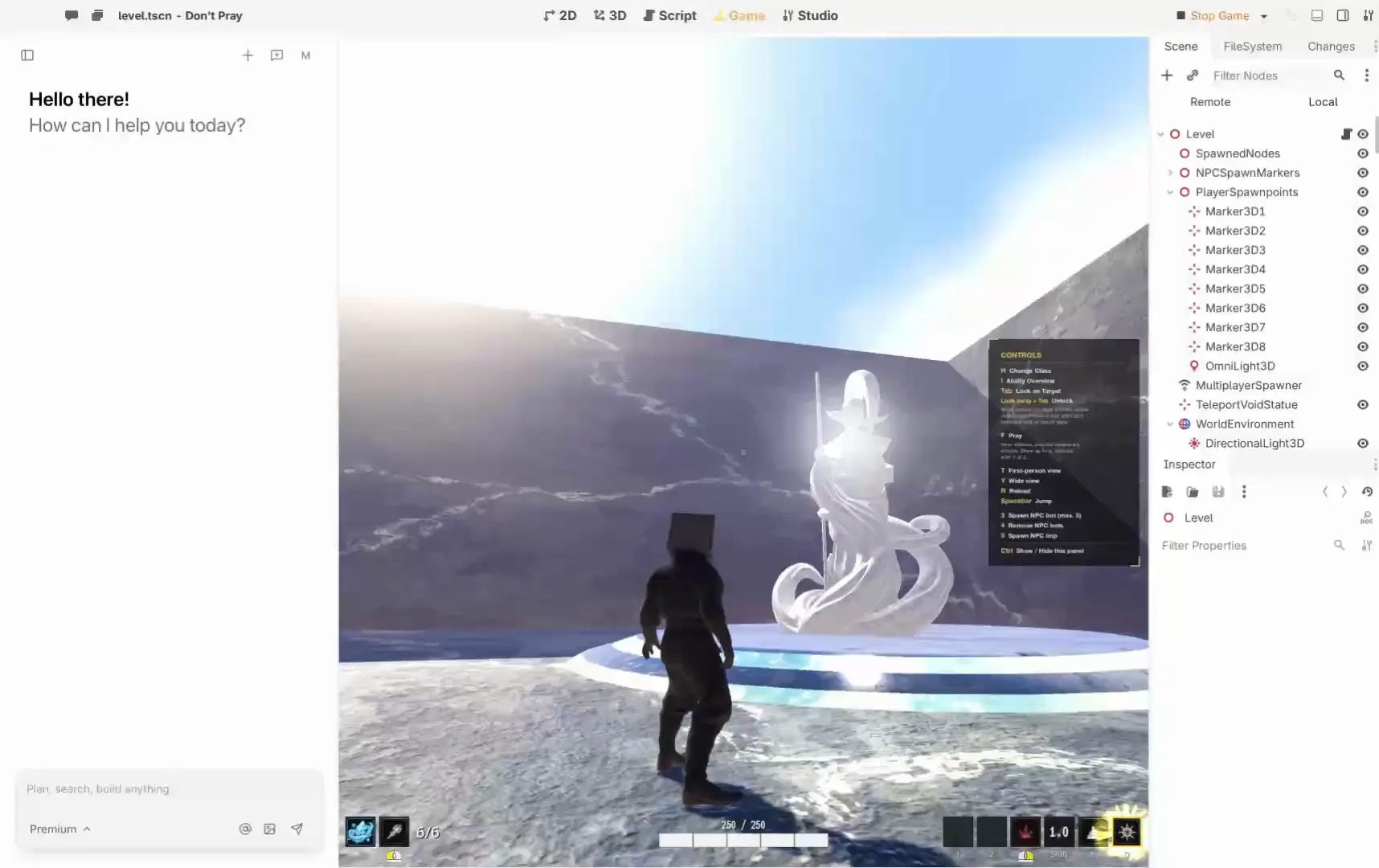
Start with the game you intend to ship. A small 2D puzzle, a 3D action prototype and a studio’s multi-platform project place different demands on an editor. For an agent-assisted workflow with editable 2D and 3D projects, evaluate Summer Engine. For open-source control, consider Godot; for a visual 2D workflow, consider Construct. Unity and Unreal are additional general-purpose choices when their workflows and terms fit the team.
A decision table
| Your constraint | What to investigate first |
|---|---|
| Small 2D game | Input, animation, collision and simple iteration |
| 3D game | Scene editing, camera, physics and performance on target hardware |
| Solo creator | Learning curve, documentation and ability to recover changes |
| Team | Version control, asset import, handoff and license costs |
| Multiple devices | Export prerequisites and a real test on every target |
2D and 3D are production choices
For 2D, create a room with movement, collision, animation and a restart. Check how the editor handles resolution and different aspect ratios. For 3D, add a camera, lighting and a moving obstacle, then check the game on the least powerful device you intend to support. Attractive editor screenshots do not establish frame rate on that device.
Match the workflow to the team
A solo creator may prefer direct agent assistance and a short feedback loop. Summer describes its editor and agent workflow on its product page. Godot’s feature overview describes its 2D and 3D tools; choose any AI integration separately. Construct’s manual describes its event-based workflow. Ask each team member to make a small change and explain how they would share it.
Target platforms before visual polish
Write down the player’s device, input and distribution channel. An engine’s platform list is a starting point, not proof that your game works there. For example, Godot documents export templates; consult the target-specific instructions as well. For Summer, review the export paths and distinguish a platform bundle from a standalone build.
Budget and rights
Record editor seats, agent usage, assets, infrastructure and platform fees. Unity’s pricing update explains its Personal threshold and cancellation of the Runtime Fee; verify current eligibility and terms before committing. Godot’s license describes its MIT terms and notice. Every project also needs rights to its own assets.
Use a common trial
- Define one small mechanic and one target device.
- Build the same playable loop in each candidate.
- Change a rule, recover an earlier version and share the project with a teammate.
- Export and run the artifact on the target device.
- Compare obstacles and costs against your actual priorities.
This is a suggested process, not a claim of measured results. The best choice is the tool whose constraints your team can accept and whose project it can maintain.
Worked example: a two-person 2D game
A designer and programmer want to ship a short puzzle game on desktop. The designer needs to change room layouts and the programmer needs to maintain the save and restart behavior. Their first test is one room with a switch, a door and a restart button. They agree that both people must be able to open the project, make a change and reproduce the same playable result.
They could start with Construct to evaluate visual events, Godot for an open-source scene-based workflow, or Summer if agent assistance inside an editable engine is a priority. For each, the designer changes the position of the switch; the programmer changes the condition for opening the door. They then export and test the build on their intended desktop operating system. The outcome depends on the actual trial; the example is a decision procedure, not a claim of comparative test results.
When 3D changes the decision
For a first-person exploration game, the camera and navigation are part of the core experience. Build a room with a door, stairs and a movable object before selecting detailed art. Try the controls on the input device the player will use. Check collision at the stairs, camera movement in a tight space and readability in a dark corner. Profile the resulting build on representative hardware instead of assuming a feature list guarantees performance.
For a side-view platform game, a 2D editor may make the core test more direct. Check sprite import, animation timing, collision and the way the view scales to a second screen size. Choose 3D only if its perspective or interaction is useful to the game; a more complex scene is not automatically a better prototype.
Team size changes the questions
A solo developer should test recovery: save a working checkpoint, make a risky change and restore the checkpoint. A two-person team should also exchange the project and rebuild it on the second machine. A larger team should inspect file conflicts, asset import, review practices, permissions and how it will track tool versions. These are operational tests to perform with the specific engine and services selected, not assumptions about any vendor.
Write down who can change gameplay rules, who approves assets and how a release is reproduced. An agent can help make a change, but a teammate still needs enough context to inspect and maintain it. If a tool requires a hosted service, include service access and expected availability in the handoff plan.
Compare delivery constraints
List every destination separately: desktop download, browser, mobile store or another platform. For each, record required accounts, SDKs, signing, input support, save behavior and a person responsible for testing. Godot’s export guide explains that export templates are needed. Construct’s publishing guide describes its publishing paths. Read the target-specific requirements before promising a release date.
A browser link is convenient to share but still needs tests for screen size, controls and persistence. A desktop package can require signing and installation checks. Mobile storefronts have their own submission requirements. An export option is evidence of a supported route, not evidence that your particular build passed.
Questions to settle before commitment
Is open source the same as free production?
No. Godot’s engine license permits use and modification under MIT terms, but staffing, assets, devices, services and distribution can still cost money. Record the notice requirement and check each dependency’s license.
Should an AI workflow decide the engine?
It can be decisive if the team wants an agent to work in the editor. Verify the connection, permissions and editability on a real small project. If the game’s target platform or a required workflow is unsupported, that requirement can outweigh the convenience of the agent.
Which choice is best for a beginner?
There is no universal answer. Choose a small project, follow one official getting-started path and see whether you can make a second change and complete a playthrough. If you cannot, reduce the scope or evaluate another tool before accumulating a large project.
Want to play instead? Discover games on Summer Games.
About this guide
By Summer. Disclosure: Summer owns this publication and it promotes Summer products. Recommendations reflect the stated use case; product information comes from the official sources linked above, checked November 8, 2026. We have not claimed comparative hands-on tests.